
Pollinators Descriptors: Artists K-T
Pollinators Exhibit
JERENE KRUSE
Albion, Nebraska
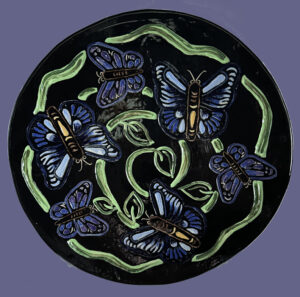
Round and Round We Go
Clay
When thinking about the theme of “Pollinators,” I aimed to create a unique style of hand-built pottery. I started the process by rolling a lump of clay into a slab and then pressing it into the shape of a large open bowl. After adding a foot to the bowl and smoothing the edges, I began carving, which I found both satisfying and thought-provoking. Next, I used underglaze to paint vibrant colors that depicted butterflies among green summer leaves. My goal was to capture the warmth of a sunny day and the joy of butterflies flitting about in a garden. The butterflies surround the leaves, symbolizing their role in pollinating the vegetation, while bringing a sense of happiness to the viewer. The title also brings to mind the idea of our world going ‘round and round’ through the years and life being sustained with the help of pollinators.
Pollinators Exhibit
KATHLEEN LOHR
Columbus, Nebraska
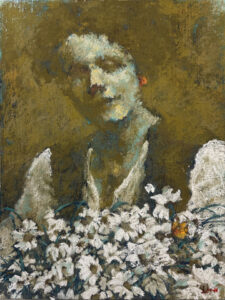
The New Victory Gardener
Pastel
A new kind of Victory Garden is essential today to ensure the survival of our pollinators. Just as the vegetable Victory Gardens of World War II helped prevent food shortages and contributed to the war effort, planting native perennial gardens that provide nutrition and shelter for our pollinators will support the growth of our global food supply. At its peak in 1944, more than 20 million Victory Gardens were planted across the country, producing 40% of all vegetables grown in the United States. Now is the time to renew that commitment and plant gardens that provide vital habitats for our pollinators.
Pollinators Exhibit
SAMMY LYNN
Glenvil, Nebraska
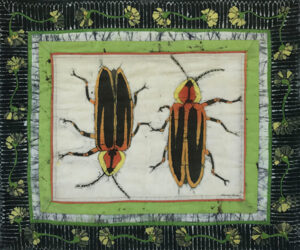
New Lights
Batik
Magic on a summer night......Fireflies! Children will chase and collect these slow-flying, amazing insects, sometimes called Lightning Bugs. What fun to fill a jar with fireflies and light up the night and our spirit. And then at bedtime, lids off but not lights out.
Pollinators Exhibit

DEBORAH MONFELT
Wymore, Nebraska
Go Tell the Bees
Oil
I share my oil painting interpretation of an old Western European custom. At one time bee keeping was of primary importance to many cultures for varied reasons including honey production and pollination. In Western Europe, perhaps shared or passed down through Celtic traditions, it was of great importance for the beekeeper to inform the hives of any historical or familial changes, including births, weddings, deaths, etc. This continues at some sites even today. When Queen Elizabeth II passed away in 2022, the royal beekeeper informed the bees of her death. It was considered bad luck for the future if the bees were not kept informed about changes in their environment.
Pollinators Exhibit

JULIA NOYES
Lincoln, Nebraska
Firefly Magic
Acrylic
I chose to paint the theme of lighting bugs at night, emitting a florescent color, because not many people know they are pollinators. The lighting bug is from the Lampyridae family, comprising over two thousand types of beetles. I hope that “Firefly Magic” evokes in you that feeling of childhood wonder that I felt when I saw fireflies at dusk.
Pollinators Exhibit

TIM O'NEILL
North Platte, Nebraska
Pollinator of Presence
Mixed Media
In this mixed media piece, the Blue Morpho serves as both subject and metaphor. While it is a literal pollinator in nature, here it symbolizes something broader: the quiet but transformative role of art itself. Like a butterfly, art can land softly—yet leaves behind something lasting, pollinating emotion.
Layered with ink, watercolor, resin, and floating gold mica, the butterfly hovers at the center of an emotional landscape. Surrounding it, hand-painted mattes transition from chaotic red-orange textures—full of movement and urgency—to a sharp, grounded gold band, and finally to a matte black frame that holds space for reflection. This contrast in color, texture, and line invites the viewer on a journey: from external intensity to internal stillness.
Pollinators Exhibit
SUE PEREZ
North Platte, Nebraska
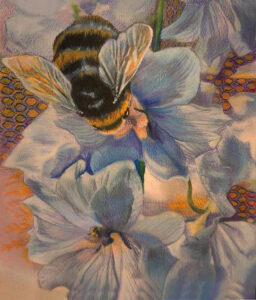
Honey, I Love You
Color Pencil
I have always loved honey. The enchantment with bees came from that love, and has always caused my attempted protection of bees in my territory. Always planting bee friendly flowers, I welcome them to my garden, and do not use pesticides. I try to create a pollinator area as a little sanctuary for my friends, as we all should if we strive to save the bee population.
Pollinators Exhibit
PATRICIA SCHEMMER
Valentine, Nebraska
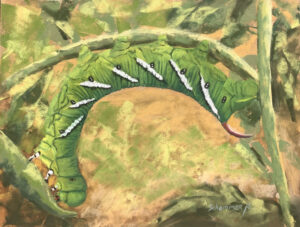
Squish Me Not
Pastel
The Tabacco hornworm (Manduca Sexta) or commonly known as the tomato worm, turns into one of nature’s special creatures that truly can hover in place. Often confused with hummingbirds, these Sphinx moths pollinate trumpet shaped flowers while feeding on their nectar.
I have always planted a tomato plant away from the main crop and relocate the larvae to feast all they want. The Sphinx moths are wonderful to watch and should be allowed to survive.
Pollinators Exhibit
DONNA SCHIMONITZ
Lincoln, Nebraska
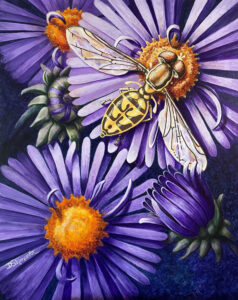
Calligrapher Fly on Purple Asters
Acrylic
Without pollinators, nearly two-thirds of our food selections would vanish. Even our milk, steak and hamburger wouldn’t exist, since cows eat hay made from pollinated alfalfa and grasses.
The calligrapher fly is one such pollinator – known as a bee and wasp “mimic.” It looks similar to bees with black and yellow coloring, giving it protection from predators, but this “flower fly” does not sting. One easy way to identify the small calligrapher fly species shown here, is by the dot near the vent end of its back. It pollinates by going from flower to flower, eating and exchanging pollen grains like bees, but without amassing pollen on its legs like bees do. Calligrapher fly larvae feed on aphids and other plant pests, making them incredibly valuable at every stage of their lives.
Pollinators Exhibit
PATSY SMITH
North Platte, Nebraska
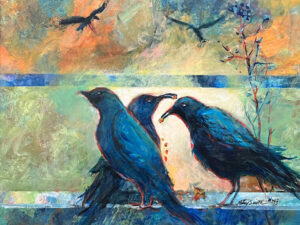
Feather Friends
Acrylic
Our feathered friends are a vital part of the "Pollinators" group. One of nature's miracles is that birds, bees, and other animals carry pollen and seeds around the earth, ensuring that our planet blooms with an exciting diversity of plant life.
Interestingly, crows pollinate various plants such as agave, erythrina, bignonia, and the bombax tree.
Pollinators Exhibit

JOAN SWIM
Springview, Nebraska
Brynna’s Pick
Oil
The path of the pollinator came at the right time, during a special plein air painting date. When asked, “What shall we paint?” my great-niece Brynna picked a beautiful planter of petunias in her grandma’s backyard. Who knew an afternoon painting simple flowers with a child could have so much impact? Sharing artistic experiences with youth is a vision of preserving our legacy.
Pollinators Exhibit
AMY TOMASEVICZ
Columbus, Nebraska
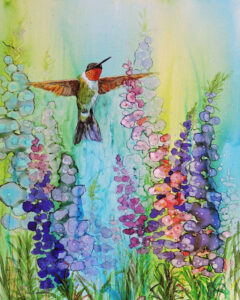
Hummingbird Among Blossoms
Alcohol Ink
To be evolutionarily successful, flowering plants need their pollen transferred from one flower's stamens to another's pistil, which is essential for pollination. This can happen in various ways. Some plants release pollen into the wind, while others produce less pollen and attract specific pollinators by offering nectar. By catering to certain animals, these plants increase the likelihood of successful pollination. Hummingbirds, in particular, play an important role in this process.