
Pollinators Descriptors: Artists A-J
To improve the educational value of Impact exhibits and engage viewers, each artwork includes a brief descriptor. This may highlight an artistic technique, tell a story, offer insight into the artist's thought process, or provide relevant background information.
Pollinators Exhibit
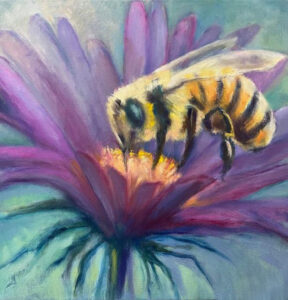
ROBERTA BARNES
Halsey, Nebraska
Blessed Bees
Oil
Bees are essential for the life of the planet. Eighty-five percent of plants exist because of bees.
Pollinators Exhibit
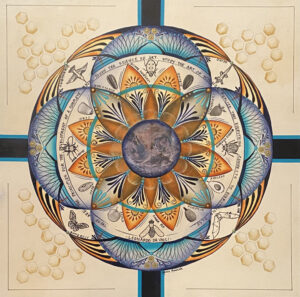
MARCIA BAUERLE
Imperial, Nebraska
Everything Connects
Mixed Media
This painting was inspired by a 500-year-old quote from Leonardo DaVinci. The mandala is formed by Sacred Geometry and depicts Earth from space, surrounded by plants, animals, and insects. It shows the intricate and interconnected web of life where all living beings depend on each other. For instance, plants rely on pollinators for their survival, and the health and nutrition of humans rely on the well-being of the plants and creatures we share this planet with. Science is dependent on art. Art is dependent on science. Everything Connects.
Pollinators Exhibit
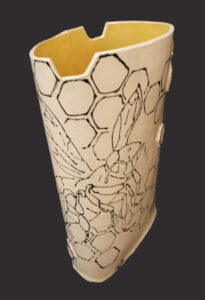
WAVA BEST
North Platte, Nebraska
The Honeybee
Stoneware
The Honeybee is a pollinator and has produced honey for as long as man can remember. They have been known to fly up to three miles to gather the nectar. When a bee finds a food source, they return to their colony and start a dance. The dance will tell the other bees the location of the flowers and how far it is. Bees are very intelligent and have compassion and a commitment to their family.
Pollinators Exhibit
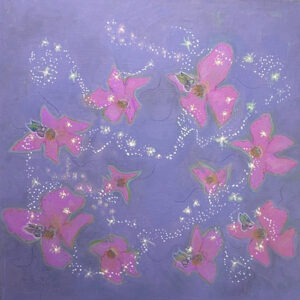
JO BROWN
Lincoln, Nebraska
Blue Bees
Mixed Media
For many years I have been fascinated by the energy that is within us and the energy that surrounds us. In a whimsical way, this painting portrays the energy and the joy that exists within the pollination process.
Pollinators Exhibit
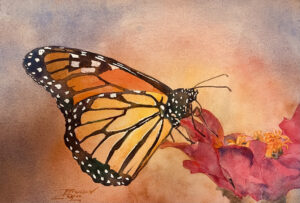
PATRICA COSLOR
Sargent, Nebraska
Monarch
Watercolor
The butterfly has a special meaning to me—It was my mother's personal symbol that brought her great joy. It is significant that it is a symbol of rebirth and life, it is fitting for her.
Pollinators Exhibit
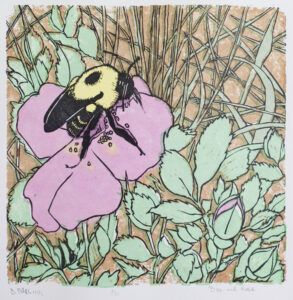
BEN DARLING
Sidney, Nebraska
Bee and Rose
Linoleum Cut
The humble bumble bee, a common pollinator here in Nebraska and North America and our wild rose. Late spring and early summer at their finest. The image is from a set of prints depicting pollinators and plants from the Great Plains.
Pollinators Exhibit
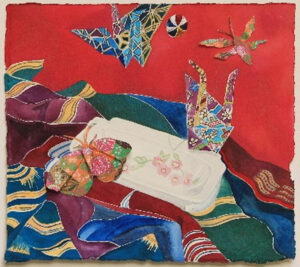
KAREN DIENSTBIER
Lincoln, Nebraska
Play Ball
Mixed Media
Pollinator Poetry: Inspired by the Chicago Botanic Gardens From the Bishops Garden
The Moth
I look for white or yellow, petals pale,
and a smell so sweet.
I reach my long tongue in to eat.
Look for me in the evening light,
while I sip nectar during flight.
Pollinators Exhibit
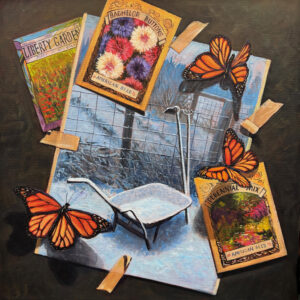
DAVID DORSEY
Valentine, Nebraska
Waiting for Spring
Acrylic
I grew up on a ranch in Rock County Nebraska. The winters were dreary, and cold, and I remember longing for the arrival of spring. I could hardly wait to hear the first killdeer and see the first signs of green bursting from the ground. I still have that longing, and I still wait to hear those sounds and signs of spring.
Pollinators Exhibit
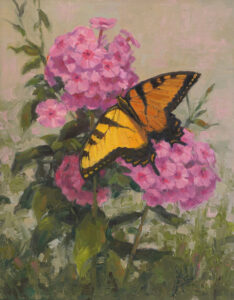
DEBRA JOY GROESSER
Ralston, Nebraska
Tiger Swallowtail and Phlox
Oil on Linen Panel
Spring is a time of rebirth, renewal and new life. No living creature embodies this more than the butterfly. It’s always such a joy when they emerge and return to my perennial garden in our backyard. This piece is the second in what will be a series focusing on butterflies found here in Nebraska, and particularly in my flower garden.
Pollinators Exhibit

JANNA HARSCH
Greenwood, Nebraska
I Thought I Saw a Hummingbird
Alkyd on Aluminum
In my day job (doing plant maintenance in downtown Lincoln, NE) I encounter many pollinators also enjoying the flowers in the annual bowls. While I remain leery of the numerous bees, I’ve been fortunate to see hummingbird moths close up.
More than 125 species in the Sphingidae family of moths live in this country. These are Hyles Lineata commonly called white lined sphinx moths. Their 2-3” wingspan and flight patterns can at first glance, fool you into thinking “Hummingbird”. A closer look will reveal their antennae and wing colors which identify them as sphinx moths. Hyles Lineata is one of the most abundant of these moths and pollinates a variety of flowers.
Pollinators Exhibit
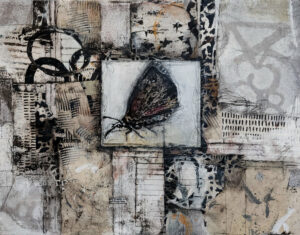
SUSAN HART
Cozad, Nebraska
Common Sooty Wing
Collage
A pollinator is anything that helps carry pollen to aid fertilization in plants. I wanted to focus on a pollinator, a butterfly that was not only common to Nebraska but to my area. I chose the Common Sooty Wing. It is the darkest of the Sooty Wing butterflies which inspired this neutral painting and a reminder that without pollinators our world would be a less colorful place.
Pollinators Exhibit
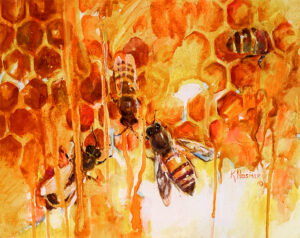
KEN HOSMER
North Platte, Nebraska
Pure Gold
Acrylic
Honeybees are crucial in pollinating many plants, including important food crops. However, their population has been declining in the U.S. in recent decades due to various factors such as parasites, pesticides, and habitat loss.
From April 2020 to April 2021, beekeepers across the U.S. lost over 45% of their managed honeybee colonies.
Pollinators Exhibit
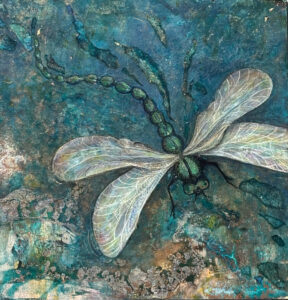
BETH JASNOCH
Kearney, Nebraska
Mid-Air Flight
Acrylic Mixed Media
Pollinators have a significant role in our ecosystems and food production. While dragonflies are not dedicated pollinators like bees or butterflies, they inadvertently transfer pollen while visiting flowers and other plants in search of prey or in seeking moisture. There is a vital ecosystem connection, and dragonflies are a part of the whole, AND they are beautiful! The iridescence of dragonfly wings reminds us of colors not found in our everyday experience.